Archives of Preventive Medicine
Accurate Rickettsia Assays for IgG and IgM Serodiagnosis
Fuller Vaccine Research Laboratory, Fullerton, CA 92831, USA
Author and article information
Cite this as
Fuller L. Accurate Rickettsia Assays for IgG and IgM Serodiagnosis. Arch Prev Med. 2026; 11(1): 4-5. Available from: 10.17352/apm.000041
Copyright License
© 2026 Fuller L. This is an open-access article distributed under the terms of the Creative Commons Attribution License, which permits unrestricted use, distribution, and reproduction in any medium, provided the original author and source are credited.It had been recommended in 2020 by the Centers for Disease Control (CDC) that serodiagnosis of acute rickettsiosis specifically utilize the IFA-IgG assay. This was a new and curious requirement for all testing facilities, namely the use of an assay that was neither described in detail nor actually relevant for acute phase diagnosis of a potentially fatal disease. A detailed protocol for this assay should have been included in this announcement to encourage rapid compliance, along with a detailed explanation of the relevance of this specific assay. This was not the case, however, with the result being false-negative IFA-IgG reports over several seasons nationally.
It had been recommended in 2020 by the Centers for Disease Control (CDC) that serodiagnosis of acute rickettsiosis specifically utilize the IFA-IgG assay. This was a new and curious requirement for all testing facilities, namely the use of an assay that was neither described in detail nor actually relevant for acute phase diagnosis of a potentially fatal disease. A detailed protocol for this assay should have been included in this announcement to encourage rapid compliance, along with a detailed explanation of the relevance of this specific assay. This was not the case, however, with the result being false-negative IFA-IgG reports over several seasons nationally.
Since IFA assays for specific Rickettsia-specific antibody remain the predominant assays utilized for serodiagnosis, the technique requires serum pre-treatment to separately and accurately identify isotype-specific antibody responses. When patient sera are pre-treated to separate these antibody isotypes in preparation for these assays, IgG-specific, IgA-specific and IgM-specific assays are both possible and accurate.
The CDC later noted that “The year-over-year analysis reveals relative stability in case counts from 2019 to 2023, with the notable exception of a 10.8% surge in 2020. While the 2020 spike initially suggested increased disease transmission, epidemiologic investigations indicate this rise likely resulted from enhanced provider awareness following CDC educational initiatives and publication of updated diagnostic guidelines rather than true disease expansion.” The educational guidelines had not actually produced a technically accurate IFA-IgG assay, which remains the case several years later, and the majority of acute Rickettsiosis results still do not demonstrate the immediate peak responses of all three major isotypes, IgG, IgA and IgM.
Class-switch recombination (CSR) allows B cells to produce antibodies with distinct effector functions. However, in the case of acute rickettsiosis, the pathogen itself initiates the immune response with all three major isotypes produced simultaneously and immediately. Thus, class-switch recombination is irrelevant to the host response in this case.
Prior to testing for specific IgG antibody, the serum IgM and IgA fractions must be either removed or specifically neutralized. This step allows reactivity without class-competition since the Rickettsia-specific reactivity is primarily directed toward the lipopolysaccharide (LPS) component of the Rickettsia envelope. Since the IgM and IgA antibodies also react to a component of this s-layer, the sheer size of these molecules precludes or reduces the binding of IgG to the LPS antigen of this outer Rickettsia membrane. The most convenient method for this step is simply the use of both goat anti-human IgM and goat anti-human IgA to simultaneously remove the competing antibody responses, which both peak simultaneously in the host.
Similar procedures are utilized prior to specific IgM testing. Removal of serum IgG antibody is accomplished by immunoprecipitation using goat anti-human IgG pre-treatment. As before, goat anti-human IgA is used simultaneously to remove competing IgA antibody. This step allows IgM reactivity specifically with the beta-peptide that is accessible on the outer surface of the Rickettsia LPS envelope.
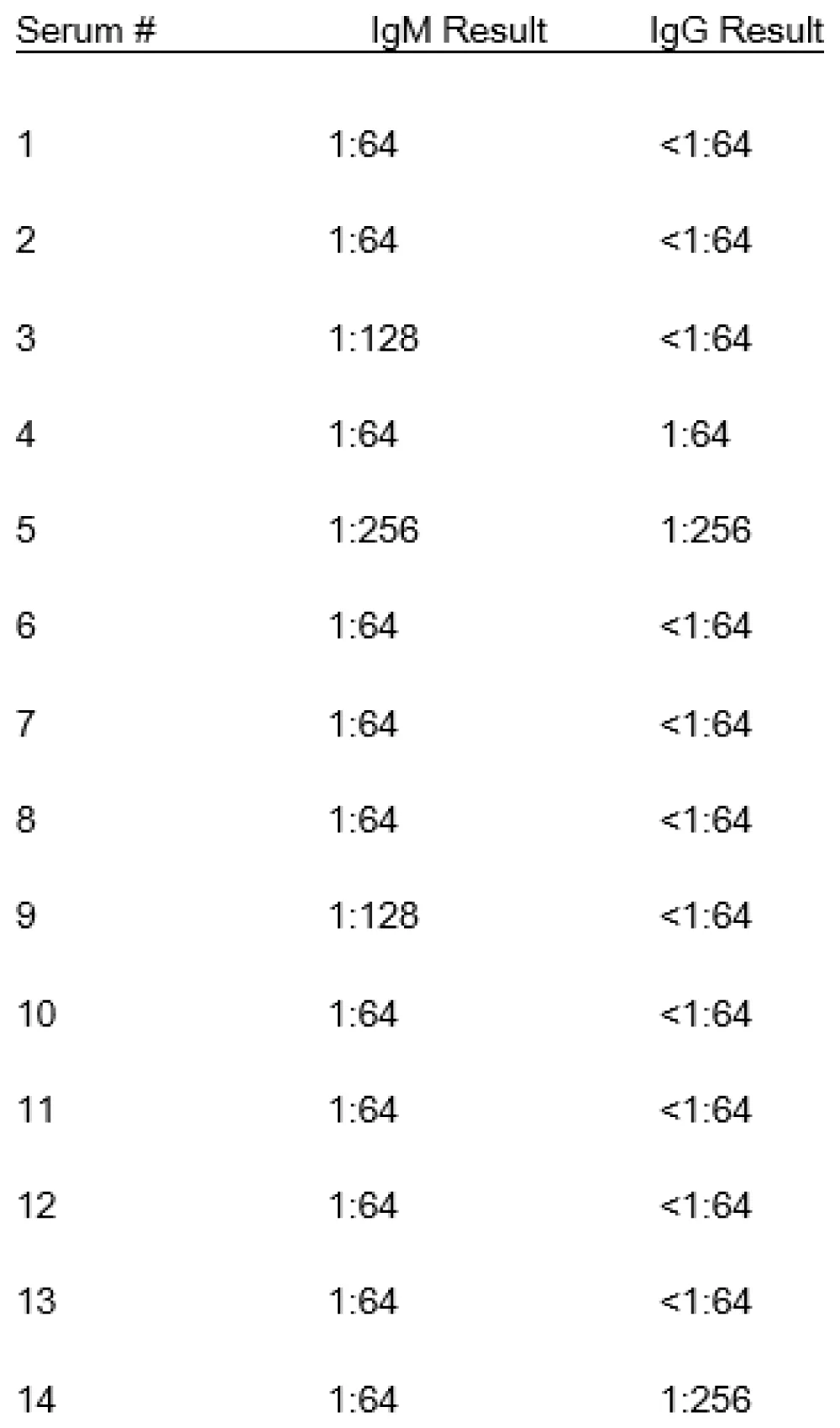
True IgG results would normally have been seen as similar in both timing and titer to the corresponding IgM titers. I suggest that the lack of correlation is due to an IFA-IgG assay protocol that did not include the necessary removal or neutralization of serum IgM and IgA isotypes prior to initiating the slide test.
ELISA protocols may also be used in Rickettsia serodiagnosis and have the added benefit of being easily automated. Reagents can be prepared in-house utilizing purified SFG Rickettsia LPS and beta-peptide coating antigens. A rigorous and reproducible procedure for isolating pure LPS must be utilized for the IgG ELISA test antigen. The source of this antigen may be any Spotted Fever Group (SFG) Rickettsia species, as this antigen is very conserved across these species. Typhus group LPS is also available using R. typhi as a source. The LPS antigen coats ELISA plates directly and can be back-coated with BSA or other protective protein.
For IgM ELISA assays the purified SFG beta-peptide can be utilized as a specific antigen by using a pre-coat of Streptavidin for strong attachment to the plastic. The beta-peptide is a small, highly conserved protein that has been sequenced and can be commercially produced at low cost. The peptide sequence is available and, although modified in vivo by peptide removal, beta-peptide antigen can be prepared using the published amino acid sequence.
ELISA is, unfortunately, seldom utilized for commercial serology due to the difficulty in translating absorbance values to “titers” in reporting results. In reporting absorbance values, reactivity classes can be produced by utilizing control sera with clear interpretive descriptions like “low”, “medium” and “high”, then using these descriptions to make absorbance values better understood in context. Another factor in the lack of Rickettsia ELISA testing is the relative lack of diagnostics manufacturers. The few manufacturers that advertise ELISA assays may attempt to portray species-specificity, although this is not possible given the many and varied species within the genus Rickettsia and the few antigens targeted in specific antibody response assays.
The Rickettsia are one of those bacterial genera that preceded the evolutionary development of mammals with their ability to generate recombinant forms of IgG and IgA following the initial IgM response. The Rickettsia initiate host antibody responses very soon after infection, apparently generating IgG, IgA and IgM simultaneously and seemingly without utilizing the recombination steps available in mammalian hosts. Thus, an IgM positive test result without a simultaneous IgG positive titer is an inaccurate and misleading test result. Much is yet to be learned about rickettsial antibody generation and the biochemical pathways involved.



 Save to Mendeley
Article Alerts
Subscribe to our articles alerts and stay tuned.
 This work is licensed under a Creative Commons Attribution 4.0 International License.