Archives of Preventive Medicine
Experience Learned from the COVID-19 Pandemic
Institute of Chinese Medicine, The Chinese University of Hong Kong, Hong Kong
Author and article information
Cite this as
Leung PC. Experience Learned from the COVID-19 Pandemic. Arch Prev Med. 2026; 11(1): 1-3. Available from: 10.17352/apm.000040
Copyright License
© 2026 Leung PC. This is an open-access article distributed under the terms of the Creative Commons Attribution License, which permits unrestricted use, distribution, and reproduction in any medium, provided the original author and source are credited.The COVID-19 Pandemic started in China in late 2019. The close geographical relationship between Hong Kong and Mainland China would not allow Hong Kong to be immune from the pandemic, which subsequently affected the island in early 2020 and kept its vitality in a wave-to-wave fashion. Four periods of relatively mild infectivity were followed by an episode of threatening experiences in the fifth wave [1,2].
The COVID-19 Pandemic started in China in late 2019. The close geographical relationship between Hong Kong and Mainland China would not allow Hong Kong to be immune from the pandemic, which subsequently affected the island in early 2020 and kept its vitality in a wave-to-wave fashion. Four periods of relatively mild infectivity were followed by an episode of threatening experiences in the fifth wave [1,2].
Throughout the pandemic years of 2020 to 2022, Hong Kong Health Authorities followed closely and effectively WHO’s guidance on vaccine provisions and effective remedial clinical measures while at the same time took serious reference to China’s approach of using Traditional Chinese Medicine in parallel with modern clinical treatment [3-5].
Evaluation of traditional chinese medicine in the management of covid-19
WHO convened a meeting of experts to evaluate the role of Traditional Chinese Medicine (TCM) in the management of COVID-19 in February 2022 in Geneva.
The meeting considered three reports on traditional Chinese medicine and COVID-19, including clinical services, research and evidence-based evaluations provided by national expert groups in China. The final evidence-based evaluation report focused on conclusions from different sources, as well as 12 randomised controlled trials (RCTs) in China, which had been registered and published [6]. After 3 days of intense reporting and discussions, recommendations were made.
The published statements included the following: -
There were promising data to suggest that TCM was beneficial in reducing the risks of progression from mild-to-moderate cases to severe COVID-19; TCM might shorten the time for viral clearance; resolution of clinical symptoms; and length of hospital stay when compared with conventional treatment alone [7].
Innate immunological defence and “trained immunity”
TCM has been used in China for centuries for the prevention and treatment of upper respiratory infections [8]. Apart from traditional reports and records, could there be more objective indications of its clinical value? If so, does TCM help to resist infection or facilitate its eradication?
In 2003, the SARS epidemic occurred in Asia. Since then, the popular use of TCM for the clinical management of respiratory infection has been established. Numerous clinical reports covering the immunological effects of the herbs used were published [8-10]. In the laboratory, the use of in vitro and in vivo platforms also succeeded in demonstrating how relevant TCM herbal extracts could boost the immunological defence system [11,12]. Our own laboratory work convinced us that cytokines closely related to inflammation and chemokines directly related to cellular responses could be upregulated in animals after consumption of the relevant herbs [13-15].
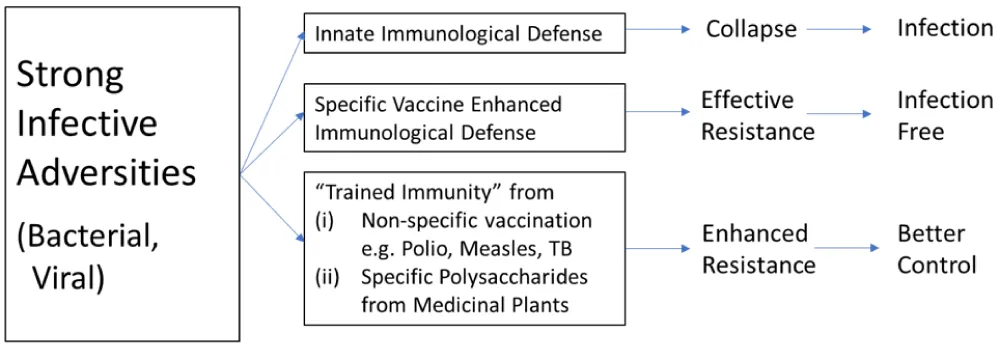
Our immune system is responsible for combating invading organisms, and under normal circumstances, without unusual virulent invasions, the system works well, without the need for any support. It is this general immunological strength of resistance to infections that keeps us away from being infected. This extra defence strength is innate in the healthy individual, not related to any medication or vaccine. This innate defence ability has been named “Trained Immunity”, which offers protection against infection beyond vaccines [16].
It has been found that innate immune responses could be enhanced and sustained following initial exposures to infectious pathogens, resulting in an immunological memory which helps to protect against re-infection. Experimental evidence was collected in animal models of fungal Candida albicans infection. Clinically, observations related to general resistance to infections after early life vaccinations against TB, measles, polio, and others have been made after extensive studies, and sustained immunological defence was observed on different occasions. Netea’s research group in the Netherlands suggested the term “Trained Immunity” to signify this phenomenon [17-19].
Trained Immunity may boost the body’s defence. Some polysaccharides in fungi and medicinal plants help to support immunological activities via the macrophage system. The herbal formulae and the herbs used could well be active candidates for the Trained Immunity Construction [20]. (Diagram).
Discussion
The COVID-19 pandemic has subsided, although cases of influenza-like infection were frequently reported to be related to variants of COVID. Upper respiratory tract infections would remain a bothersome health problem [21].
Since 1911, 7 epidemics of pandemic scale related to influenza-like infection occurred in China: 4 of which (1918, 1957, 1968, 1977) affected China itself and other countries; while 3 others affected China alone (1997, 1999 and 2003). The 1918 pandemic was the most damaging one ever reported of the influenza virus. China apparently was not as severely hit, and the mortality was low. One reason postulated was that although modern medicine was not developed in China and no vaccine was available, TCM contributed a lot to the control of the infection [22,23].
We are still in the active era of vaccine creation, which is taken as the only solution for infection prevention. It is a real pity that the innate aspect of an individual’s ability of immunological defense has not been included in most discussions on infection prevention. There is still hope that before the COVID-19 pandemic disappears from people’s minds, the immunological support given by specific chemicals and herbs could be fully explored and offered as a powerful self-defence booster. As advised by the WHO experts, more systematic research efforts and arrangements on the effects of relevant herbs to boost innate immunological defence need to be considered.
- Leung PC, Chan CLB, Wong CK. What do we expect from Traditional Chinese Medicine in the COVID-19 pandemic? Chin Tradit Med J. 2020;3(1). Available from: https://www.researchgate.net/publication/341566119_What_do_we_expect_from_Traditional_Chinese_Medicine_in_the_COVID-19_Pandemicc
- Leung PC, Chan CLB, Wong CK. Clinical use of Chinese medicine in the current COVID-19 crisis and related research planning. Clin Res Infect Dis. 2020;5(1):1054. Available from: https://www.jscimedcentral.com/journal-article-info/Clinical-Research-in-Infectious-Diseases/Clinical-Use-of-Chinese-Medicine-in-the-Current-COVID-19-Crisis-and-Related-Research-Planning--2776#
- Luo H, Tang QL, Liu JP. Can Chinese medicine be used for prevention of coronavirus disease 2019 (COVID-19)? A review of historical classics, research evidence and current prevention programs. Chin J Integr Med. 2020;26:243-250. Available from: https://doi.org/10.1007/s11655-020-3192-6
- Leung PC. Epidemic diseases and Chinese medicine: from ancient to current time. J Trop Med Infect Dis. 2020;1:001. Available from: https://doi.org/10.29011/JTMID-101.100001
- Chan KW, Wong VT, Tang CW. COVID-19: an update on the epidemiological, clinical and guidelines of integrative Chinese-Western medicine for the management of 2019 novel coronavirus disease. Am J Chin Med. 2020;48:737-762. Available from: https://doi.org/10.1142/s0192415x20500378
- World Health Organization. WHO expert meeting on evaluation of Traditional Chinese Medicine in the treatment of COVID-19, 28 February-2 March 2022. Geneva: World Health Organization; 2022. Available from: https://www.who.int/publications/m/item/who-expert-meeting-on-evaluation-of-traditional-chinese-medicine-in-the-treatment-of-covid-19
- World Health Organization. Traditional and integrative medicine. Geneva: World Health Organization; 2022.
- Lau TF, Leung PC, Ko WM, Fong C, Cheng KF, Zhang SC, et al. Using herbal medicine as a means of prevention: experience during the SARS crisis. Am J Chin Med. 2005;33:345-356. Available from: https://doi.org/10.1142/s0192415x05002965
- Poon PMK, Wong CK, Wong ELY, Leung PC, Lam WK, Lau CBS, et al. Immunomodulatory effects of a traditional Chinese medicine formula with potential antiviral activities. Am J Chin Med. 2006;34:13-21. Available from: https://doi.org/10.1142/s0192415x0600359x
- Leung PC. The efficacy of Chinese medicine for SARS: a review of Chinese publications after the crisis. Am J Chin Med. 2007;35(4):575-581. Available from: https://doi.org/10.1142/s0192415x07005077
- Fung KP, Leung PC, Wong KB, Waye MY, Au WN, Lau BSC, et al. Immunomodulatory activities of the herbal formula Kwan Du Bu Fei Dang in healthy subjects: a randomized, double-blind, placebo-controlled study. Hong Kong Med J. 2011;17 Suppl:S41-S43. Available from: https://pubmed.ncbi.nlm.nih.gov/21368336/
- Ragupathi G, Yeung KS, Leung PC, Lee M, Lau CBS, Vickers A, et al. Evaluation of widely consumed botanicals as immunological adjuvants. Vaccine. 2008;26:4860-4865. Available from: https://doi.org/10.1016/j.vaccine.2008.06.098
- Poon PMK, Wong CK, Fung KP, Fong CYS, Wong ELY, Leung PC, et al. Immunomodulatory effects of a traditional Chinese medicine with potential antiviral activity: a self-controlled study. Am J Chin Med. 2006;34:13-21. Available from: https://doi.org/10.1142/s0192415x0600359x
- Hong F, Xiao WL, Ragupathi G, Lau CBS, Leung PC, Yeung KS, et al. The known immunologically active components of Astragalus account for only a small proportion of the immunological adjuvant activity when combined with conjugate vaccines. Planta Med. 2011;77:817-824. Available from: http://dx.doi.org/10.1055%2Fs-0030-1250574
- Yue GGL, Chan BCL, Hon PM, Kennelly EJ, Yeung SK, Cassileth BR, et al. Immunostimulatory activities of polysaccharide extract isolated from Curcuma longa. Int J Biol Macromol. 2010;47:342-347. Available from: https://doi.org/10.1016/j.ijbiomac.2010.05.019
- Chan CL, Leung PC, Cheng KF, Wong CK, et al. Going along the direction of trained immunity: a herbal supplement for the prevention of respiratory infection. J Vaccines Immunol. 2020;6(1):32-37. Available from: https://doi.org/10.17352/jvi.000035
- Netea MG, Dominguez-Andres J, Barreiro LB, Chavakis T, Divangahi M, Fuchs E,et al. Defining trained immunity and its role in health and disease. Nat Rev Immunol. 2020;20:375-388. Available from: https://doi.org/10.1038/s41577-020-0285-6
- van der Meer J, Joosten LAB, Netea MG. Trained immunity: a smart way to enhance innate immune defence. Mol Immunol. 2015;68:40-44. Available from: https://doi.org/10.1016/j.molimm.2015.06.019
- Netea MG, Giamarellos-Bourboulis EJ, Dominguez-Andres J, Curtis N, van Crevel R, van de Veerdonk FL, et al. Trained immunity: a tool for reducing susceptibility to and the severity of SARS-CoV-2 infection. Cell. 2020;181:969-977. Available from: https://doi.org/10.1016/j.cell.2020.04.042
- Quintin J, Saeed S, Netea MG, Ifrim DC, Logie C, Jacob L, et al. Candida albicans infection affords protection against reinfection via functional reprogramming of monocytes. Cell Host Microbe. 2012;12:223-232. Available from: https://doi.org/10.1016/j.chom.2012.06.006
- Department of Health, Hong Kong. Announcement. Hong Kong: Department of Health; 2026.
- Cheng KF, Leung PC. What happened in China during the 1918 influenza pandemic? Int J Infect Dis. 2007;11(4):360-364. Available from: https://doi.org/10.1016/j.ijid.2006.07.009
- Leung PC. Epidemic diseases and Chinese medicine: from ancient to current time. J Trop Med Infect Dis. 2020;1:001. Available from: https://doi.org/10.29011/JTMID-101.100001

 Save to Mendeley
Article Alerts
Subscribe to our articles alerts and stay tuned.
 This work is licensed under a Creative Commons Attribution 4.0 International License.